Platform / Ontology
The structure behind every number.
Trebellar's ontology unifies your leases, headcount, cost, and space data into one connected model.
Request a Demo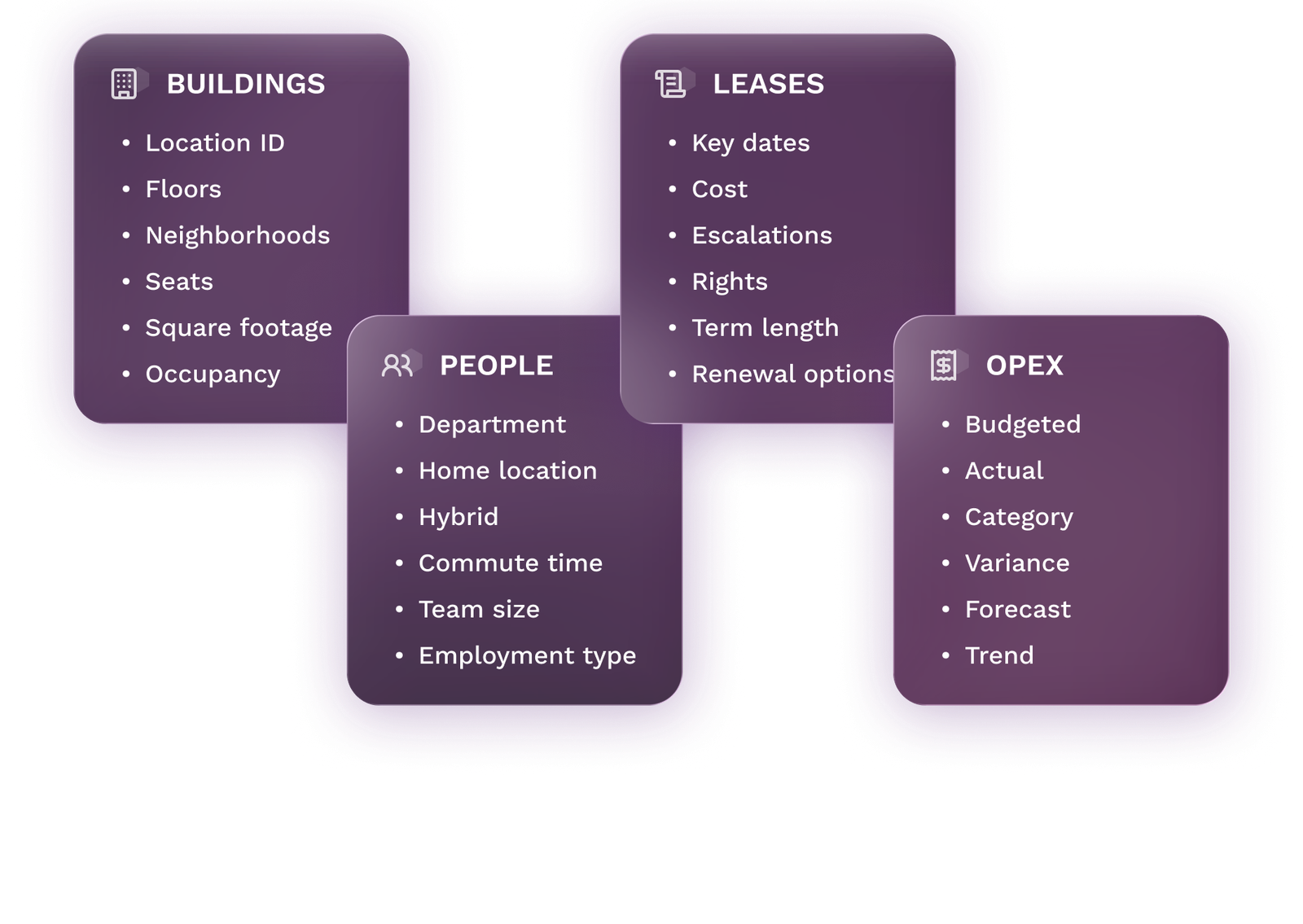

Platform / Ontology
Trebellar's ontology unifies your leases, headcount, cost, and space data into one connected model.
Request a Demo
Every object, field, and relationship reflects how CRE actually works – not a general schema.

Calculations are run against your ontology, not a guess – so you can verify, not just trust.

Our platform is designed to handle data of any type, in any format: structured, semi-structured, unstructured.

General BI and LLMs aren't built for the nuance and calculation rigor real estate demands. Trebellar is.

Flexible ingestion options match your systems, timeline, and IT readiness.

High-stakes decisions deserve data you can verify, not just numbers you're asked to trust.
No more silos – just clean, structured data that's AI-ready. Trebellar's ontology normalizes data from every source into one connected model, purpose-built for CRE.

Track spend and key lease dates to uncover savings opportunities.
Connect badge data, WiFi analytics, sensors, and space booking tools.
Select sites with confidence using instant AI-powered market insights.
See space-booking trends and improve utilization with room-release policies.
Understand what supports engagement and adjust seat allocations with agility – without touching personal data.
Streamline site operations with workflow automation that's easy to set up and maintain.
Upload via CSV, connect through our API, or add custom research and policy documents in a few clicks.
The same ontology that structures your data also trains the models and agents that act on it.

Trace any figure back to the lease clause or record it came from – no digging required.

Get flagged the moment an inconsistency appears, not after a stakeholder sees it.

Let ML models trained on your ontology predict attendance, cost, and demand trends.

Pull consistent, structured data across every location – no manual reconciliation.
FAQ
Still have a question?
A structured model of your real estate portfolio – every lease, building, team, and cost, connected the way your business actually works. It's what lets an AI understand what each data set means and how they relate to one another.
It depends on the ingestion method. CSV upload can take as little as 2–3 weeks; a direct warehouse connection or full API integration typically takes 2–6 weeks. Most customers start with CSV or file sync, then move to API over time.
Not necessarily. CSV upload and secure file sync require minimal IT lift. And generally speaking, we don't use personal identifiable information (PII). API integration and direct warehouse connections benefit from IT coordination, but aren't required to see initial value.
Yes. Every calculation traces back to its source record – the lease, the badge swipe, the headcount entry – so you can verify any figure, not just trust it.
No, we do not use customer data to train general models or other customer models. We enforce strict segregation of customer data. Customers retain ownership of their data.
Lease and OPEX systems, market data providers, occupancy and utilization tools (badge, WiFi, sensors), space reservation platforms, HRIS and survey tools, IoT and operations platforms, plus custom uploads via CSV, PDF, or API.
Agents plan, calculate, and generate reports using this same ontology, so the numbers they cite are the same governed, traceable data you'd find anywhere else on the platform.

